

Hagia Sophia Architecture
The Hagia Sophia architecture is one of the greatest achievements in architectural history. Completed in 537 AD during the reign of Emperor Justinian I, the building introduced engineering techniques that were centuries ahead of their time. Its enormous central dome, innovative structural design, and harmonious blend of light, marble, and mosaics influenced countless churches and mosques across Europe and the Middle East.
Today, visitors admire Hagia Sophia not only for its religious significance but also as one of the world's most remarkable architectural monuments. Exploring Hagia Sophia architecture provides valuable context for its massive dome, marble interiors, Byzantine mosaics, and later Ottoman additions.
Who Built the Hagia Sophia?
The Hagia Sophia was commissioned by Emperor Justinian I after the previous church on the site was destroyed during the Nika Revolt of 532 AD. It was designed by Anthemius of Tralles and Isidore of Miletus, two of the Byzantine Empire's most accomplished mathematicians, engineers, and scholars. Their expertise in geometry, mechanics, and physics enabled them to develop innovative structural solutions that transformed Byzantine architecture.
Following the partial collapse of the original dome, Isidore the Younger, the nephew of Isidore of Miletus, oversaw its redesign, improving the structure's stability while preserving the architects' original vision. Together, their work established Hagia Sophia as one of history's greatest architectural achievements.
What is the Architectural Style of the Hagia Sophia?
The Hagia Sophia architecture is widely regarded as the greatest surviving example of Byzantine architecture. Completed in 537 AD, it introduced a revolutionary design that combined the traditional longitudinal basilica with a vast centralized dome, setting a new standard for monumental religious buildings.
Following the Ottoman conquest of Constantinople in 1453, Islamic architectural elements such as minarets, a mihrab, and a minbar were integrated into the existing Byzantine structure. Hagia Sophia later became the principal inspiration for the Ottoman imperial mosque tradition, influencing the designs of Mimar Sinan, including the Süleymaniye Mosque and the Selimiye Mosque.
What Makes Hagia Sophia Architecture So Famous?
Hagia Sophia is famous for its massive central dome, innovative pendentive system, and pioneering Byzantine engineering. Completed in 537 AD, it introduced architectural solutions that allowed an enormous dome to rest above a vast open interior, influencing church and mosque design for centuries. Today, it is considered one of the greatest masterpieces of Byzantine architecture.
Several innovations made Hagia Sophia revolutionary:
Highlights of Hagia Sophia Architecture
The Hagia Sophia architecture is defined by a combination of innovative engineering, monumental scale, and refined decoration. From its soaring central dome to its marble-clad walls and sophisticated structural system, these architectural elements helped redefine Byzantine architecture and continue to impress visitors today.
The Dome
The Hagia Sophia Dome is the most iconic architectural feature. Measuring approximately 31 meters (102 feet) in diameter and rising about 55.6 meters (182 feet) above the floor, it transformed Byzantine engineering and remained one of the world's largest domes for nearly a thousand years.
The Pendentives
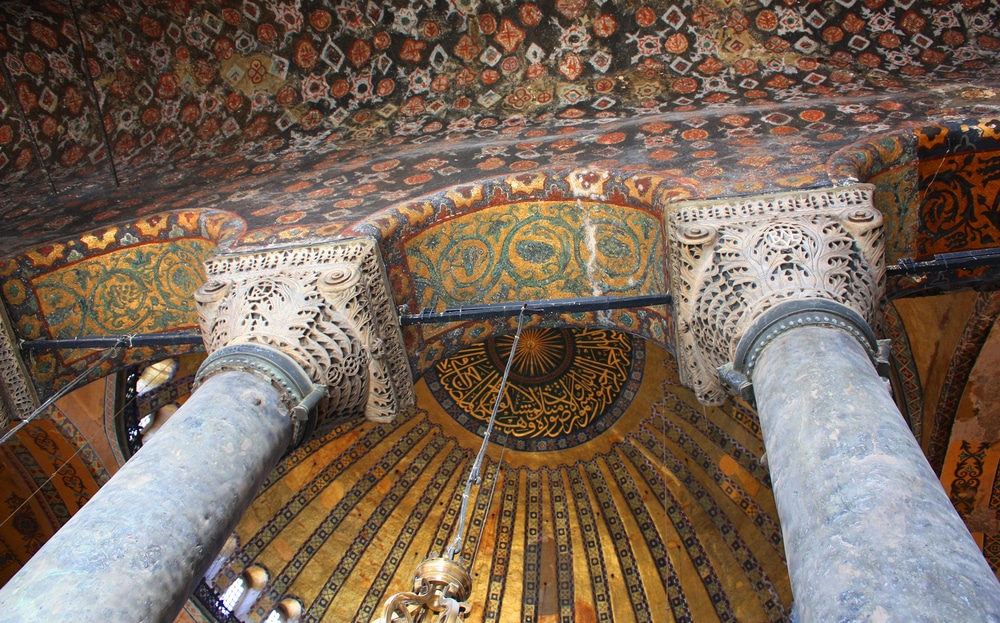
Hagia Sophia was one of the first monumental buildings to use pendentives on such a large scale. These curved triangular sections transfer the dome's weight onto four massive piers, creating a spacious interior while allowing the dome to appear remarkably light and elegant.
The Semi-Domes
Two large semi-domes support the central dome from the east and west, helping distribute its enormous weight. Together with smaller vaulted spaces, they strengthen the structure, enlarge the prayer hall, and create Hagia Sophia's distinctive cascading roofline visible from the exterior.
Marble Columns & Capitals
More than 100 marble columns support Hagia Sophia's galleries and arcades. Many were brought from earlier Roman temples across the empire, while their finely carved capitals combine classical influences with distinctive Byzantine craftsmanship that enhances the building's monumental interior.
Marble Wall Decoration
Instead of painted walls, Hagia Sophia features large marble panels carefully arranged in symmetrical patterns. Builders selected stones from across the Byzantine Empire, matching their natural veining to create decorative designs that remain one of the building's most impressive artistic details.
Other Structures
Other structures were added to the interior of the Hagia Sophia building during the Ottoman period; one of them is Murad III, who placed two jars made of "bektashi stone" (Eng. alabaster) from the Hellenistic Period (4th century BC) found in Pergamon in the main nave (main hall) of Hagia Sophia, and sherbet was served from them on special occasions. Currently, visitors can see the magnetic bektashi stone.
What's Inside Hagia Sophia?
Beyond its remarkable architecture, Hagia Sophia contains some of Istanbul's most important historical and artistic treasures. Visitors can discover Byzantine mosaics, Islamic architectural elements, imperial spaces, and decorative details that reflect nearly 1,500 years of history.
- Byzantine Mosaics: Gold mosaics depicting Christ, the Virgin Mary, emperors, and saints that survived centuries of change.
- The Mihrab: The beautifully decorated prayer niche added after the Ottoman conquest, indicating the direction of Mecca.
- The Minbar: An elegant marble pulpit used for Friday sermons since Hagia Sophia became a mosque.
- The Imperial Gate: The grand ceremonial entrance once reserved exclusively for Byzantine emperors.
- The Omphalion: A circular marble floor section believed to have been used for Byzantine imperial coronations.
- The Upper Gallery: Home to important mosaics and offering panoramic views of the monumental interior.
- The Giant Calligraphy Medallions: Massive wooden roundels displaying the names of Allah, the Prophet Muhammad, and early Islamic figures.
→ Planning a visit? Discover what else is there to see inside Hagia Sophia.
Construction of Hagia Sophia
The remarkable Hagia Sophia architecture did not emerge overnight. From its original construction under Emperor Justinian I to later Byzantine repairs and Ottoman modifications, the building evolved over nearly 1,500 years while preserving its distinctive Byzantine character.
The Original Construction (537 AD)
Commissioned by Emperor Justinian I, Hagia Sophia was completed in just under six years. Architects Anthemius of Tralles and Isidore of Miletus designed an unprecedented structure centered around a vast dome supported by pendentives, creating one of the largest interior spaces of the ancient world.
The Dome Reconstruction
The original dome partially collapsed after an earthquake in 558 AD. Isidore the Younger redesigned it with a steeper profile and raised its height, making the structure more stable. Much of the dome visitors see today dates from this reconstruction.
Byzantine Restorations
Over the following centuries, earthquakes repeatedly damaged Hagia Sophia. Byzantine emperors strengthened the building with repairs to the dome, arches, and supporting walls while preserving its original architectural concept.
Ottoman Architectural Additions
After the Ottoman conquest in 1453, architects gradually added four minarets, buttresses, a mihrab, a minbar, and the Sultan's lodge. These additions strengthened the structure while transforming it into an imperial mosque without fundamentally altering its Byzantine core.
Modern Conservation
Since the 19th century, several restoration campaigns have focused on preserving both Byzantine and Ottoman architectural elements. Today, conservation work continues to protect Hagia Sophia's unique structure for future generations.
Top Bestseller Hagia Sophia Tickets
Save time with these skip-the-line entry tickets to Hagia Sophia, including an audio guide. Marvel at the beauty of this UNESCO World Heritage Site. + more details
Skip the ticket line and experience one of Istanbul’s most iconic landmarks with access to the Upper Gallery and a multilingual audio guide. + more details
Experience the legendary Hagia Sophia with skip-the-line access, a rich audio guide in 8 languages, and cutting-edge augmented reality experience for your smartphone to bring its magnificent history to life. + more details
Step inside the impressive Hagia Sophia and gain deeper insight into its extraordinary history and architecture with a 1-hour guided tour in English, a multilingual audio guide, and skip-the-line access. + more details
Discover 3 of Istanbul's most famous monuments with this combined guided tour. Avoid the queues at the Basilica Cistern and Hagia Sophia, and visit the Blue Mosque with an English-speaking guide. + more details
Most Popular Combo Tickets
Unlock Istanbul's heritage with this super combo: effortlessly explore the awe-inspiring Hagia Sophia, the mysterious Basilica Cistern and the magnificent Topkapi Palace, with skip the line entry and an audio guide. + more details
Bypass the queues at the enchanting Basilica Cistern and the iconic Hagia Sophia, with an enriching audio guide to bring their captivating stories to life. + more details
Combo Ticket with the Hagia Sophia Museum
Your complete experience pass to discover the fascinating history of Hagia Sophia: mosque and interactive museum. + more details
Frequently Asked Questions (FAQ) - Hagia Sophia Architecture
Which architectural component supports the dome of the Hagia Sophia?
The Hagia Sophia dome is supported by four massive piers connected by pendentives—curved triangular sections that transfer the weight of the circular dome onto a square base. Large semi-domes and exterior buttresses also help distribute structural forces, allowing the enormous dome to remain stable while creating a vast, open interior.
What is the architectural style of the Hagia Sophia?
Hagia Sophia is considered the finest surviving example of Byzantine architecture. Its innovative design combines a traditional basilica plan with a monumental central dome, a breakthrough that transformed religious architecture. Following the Ottoman conquest in 1453, Islamic features such as minarets and a mihrab were added, creating the distinctive blend of Byzantine and Ottoman architecture seen today.
What is so unique about the Hagia Sophia architecture?
The Hagia Sophia architecture is renowned for its massive central dome, pioneering pendentive system, and vast open interior. When completed in 537 AD, it introduced engineering solutions that had never before been achieved on such a scale. Its design influenced Byzantine churches, Ottoman imperial mosques, and later Renaissance architecture, making it one of history's most important architectural landmarks.
Who were the two architects of the Hagia Sophia?
Hagia Sophia was designed by Anthemius of Tralles and Isidore of Miletus, two Byzantine mathematicians, engineers, and scholars commissioned by Emperor Justinian I. Their innovative use of geometry and structural engineering allowed them to construct one of the world's largest domes and create a building that became the defining masterpiece of Byzantine architecture.
Is a guided tour worth it for Hagia Sophia architecture?
Yes, especially if you're interested in history, architecture, or engineering. While you can admire Hagia Sophia's impressive interior on your own, many of its most remarkable architectural details—including the pendentives, dome construction, marble decoration, and Byzantine design innovations—are easy to overlook without explanation. A guided tour or audio guide provides valuable context that helps visitors better understand the building's architectural significance.
LEARN MORE
LEARN MORE